2022
Overview
DBSync for Database To Salesforce Integration is an easy to use solution. It integrates Database with Salesforce objects like accounts, contacts, products, opportunity & opportunity line items.
Data Flow
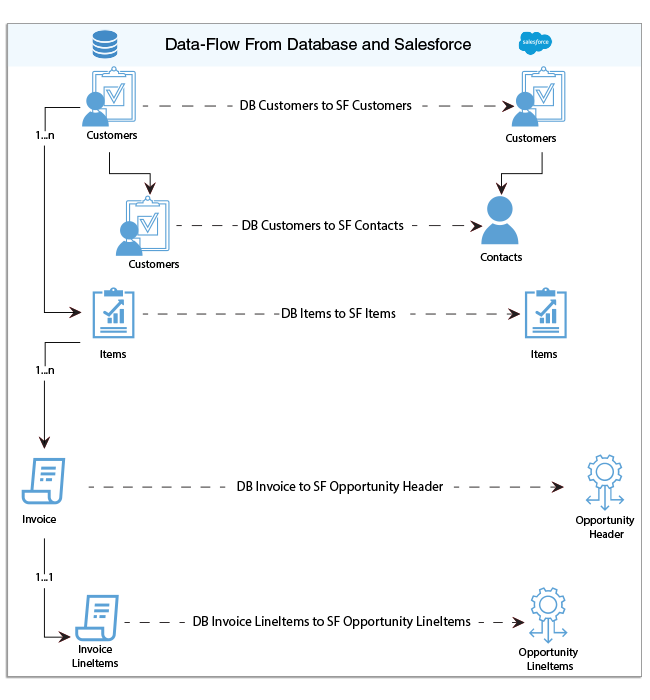
This tutorial shows how to read various records from Database and write to the respective mapped objects of Salesforce . The table below shows the data flow between tables from Database to Salesforce objects. The data flow may be different for each implementation. The following table is just one of the examples:

Process Map
The process map for Database To Salesforce solution is as shown in image below:
Prerequisites For Integration
The integration prerequisites are as follows:
- Have valid licenses to DBSync Salesforce, Database Connector and Username and Password to connect with DBSync iPaaS platform.
- Have Salesforce login and password to access their Web Services.
- Setup security in Salesforce to connect to external integration.
- Have a valid database Username, Password, host/IP address and Port on the hosted database.
The Username and Password configured for Database Connector instance should have sufficient privilege to access the database required for integration.
Configuring Source App
Follow the steps below to get started with a database and to configure the database connector.
- The table below gives the required, and optional, parameters to be set for establishing a connection of database and to write various tables as chosen in the relevant workflows.
- Click Save to save the parameter settings:
| Property | Description | Required |
|---|---|---|
| Username | Database Username | Yes |
| Password | Database Password | Yes |
| Host | Host name or IP address of the database server | Yes |
| Port | The port used to connect to database server | Yes |
| Database | The name of your database | Yes |
| Type | JDBC Driver for the Databases mentioned in the URL section in the same order.
| Yes |
| Database URL | JDBC connection string
| Yes |
Configuring Target App
Follow the steps to configure the DBSync's Salesforce Connector:
- Click Edit on the Salesforce connector to input Salesforce parameters.
- Click Save to save the settings.
The table below gives the required, and optional, parameters to be set for establishing a connection of Salesforce from which you can read the data and write to Salesforce.
Property | Description | Required |
|---|---|---|
UserName | The username to log into salesforce account. | Yes |
Password | The password to login to salesforce account | Yes |
End-point | Yes | |
Sid | Session Id | Optional |
Transport.compression | For compression | Optional |
Proxy Host | If you use a proxy server then put <<proxy ip or host>> | Optional |
Proxy Port | If you use a proxy server then put <<proxy port>> | Optional |
Proxy Username | If you use a proxy server then put <<proxy username>> | Optional |
Proxy Password | If you use a proxy server then put <<proxy password>> | Optional |
Accept Gzip | As Applicable | Optional |
Send Gzip | As Applicable | Optional |
For the sake of understanding, we have chosen MySQL database with tables like - Contacts, Customers, Items, Oppheader, Opplineitem. Data from the database is sent to configured Salesforce instance. You can download the sql script from download script link. Then, import the table structures into your MySQL database if you have the same integration requirement listed in the tutorial.
DBSync Project Setup
- Login into www.mydbsync.com. Click on Customer Login.
- Enter your DBSync Username and Password and click on Login.
- Once logged in, click on template library menu from the left side navigation.
- Search for template name Salesforce To Database: uni-directional template and, import to your workspace.
- You will be re-directed to Connector listing of the Salesforce To Database: uni-directional template.
- In the Connector listing page, you can see Salesforce and database Connector.
- Click Edit to configure Connectors respectively. Individual Connector configuration are explained in the subsequent sections.
- Navigate to the process listing page to view the pre-defined mappings.
- Various transformations can be applied to each field through the mapping section. Then, save the workflow
- Click 'Run Now' button to initiate the integration of the selected workflow.
- The sync can be monitored through the log section in event of the error. You can also drill down to each event log to debug, and to fix, the error at its occurrence.
Run Integrations
Integration can be run using scheduler; or, by clicking on the 'Run Now' button. Scheduler job are used to trigger process at scheduled time interval automatically. On the other hand, manual trigger of the sync can be initiated by clicking on the 'Run Now' button from the process listing page/workflow page.
Scheduler
To create a scheduler job, follow the steps below.
- Inside a Project, navigate to the Scheduler page from the left side navigation.
- From the 'Add schedule section' create a schedule job. Select the process from the drop down then choose start on date , start on time and repeat frequency. Save the job.
- If repeat frequency is set to no repeat then, the scheduled job triggers syncs only once - as per scheduled date and time.
- If repeat frequency is set to either minutes, hourly or weekly then, the process is scheduled to run at the repeated set frequency.
Run Now
To manually trigger the sync, click Run Now button:
- From the Process listing page.
- From the Workflow listing page.
- From the Trigger page.
Related References
Overview
Content Tools